












Hardness Testing Knowledge – Understanding Modern Hardness Testing Methods
Hardness testing is one of the most important methods used in material testing, quality control, and industrial manufacturing. It provides critical information about a material’s resistance to deformation, wear, penetration, and overall mechanical performance.
Across industries such as automotive, aerospace, energy, heat treatment, tooling, steel production, and fastener manufacturing, hardness testing plays a vital role in verifying product quality, ensuring compliance with international standards, and supporting long-term reliability.
Whether testing raw materials, finished components, welded structures, heat-treated parts, or coatings, selecting the correct hardness testing method is essential for accurate and repeatable results.
What is Hardness Testing?
Hardness testing measures a material’s resistance to permanent deformation caused by an applied force using a specific indenter geometry under controlled conditions.
Depending on the test method, hardness is determined by measuring:
The result helps manufacturers evaluate:
Hardness testing is one of the fastest and most reliable non-destructive or semi-destructive methods for process verification and material qualification.
Choosing the Right Hardness Testing Method
Different applications require different hardness testing methods.
Rockwell Hardness Testing
Ideal for fast production testing and quality control, especially for metals and hardened components. Rockwell testing measures hardness by depth of penetration and is widely used in high-throughput manufacturing environments.
Vickers Hardness Testing
Used for precise laboratory testing, microhardness applications, coatings, weld testing, and case depth analysis. Vickers testing offers high accuracy across a wide range of materials and loads.
Brinell Hardness Testing
Best suited for large castings, forgings, coarse-grain materials, and softer metals where larger indentations provide more representative results.
Knoop Hardness Testing
Primarily used for brittle materials, ceramics, coatings, and very thin sections where shallow indentation depth is critical.
Each method has specific standards, applications, and advantages depending on the material and testing objective.
Hardness Testing Standards and Compliance
Reliable hardness testing requires compliance with internationally recognized standards such as:
Examples include:
Standards ensure test accuracy, repeatability, traceability, and audit readiness.
Hardness Testing in Modern Manufacturing
Today’s manufacturing environments demand more than just measurement—they require automation, repeatability, data integrity, and full digital traceability.
Modern hardness testing systems combine:
This transforms hardness testing from a simple inspection step into a fully integrated quality assurance process.
Why Hardness Testing Matters
Incorrect hardness values can lead to:
Accurate hardness testing protects product performance, production quality, and brand reputation.
For this reason, hardness testing remains one of the most critical disciplines in industrial materials verification.
Choosing the correct hardness testing method is one of the most important decisions in material testing, quality control, and manufacturing. The three most widely used methods—Brinell hardness testing, Rockwell hardness testing, and Vickers hardness testing—each serve different purposes depending on the material, application, and required accuracy.
Understanding the differences between these methods helps manufacturers improve testing efficiency, maintain compliance with international standards, and ensure consistent product quality.
Whether testing large castings, heat-treated gears, welded components, fasteners, coatings, or aerospace alloys, selecting the right hardness test directly impacts reliability, repeatability, and production performance.
Rockwell Hardness Testing
Best for High Throughput Production Testing
Rockwell hardness testing is one of the fastest and most commonly used methods in industrial manufacturing. It measures hardness by calculating the depth of penetration under a minor and major load.
Key Advantages
Common Applications
Common Standards
Rockwell testing is ideal when speed and repeatability are the highest priorities.
Brinell Hardness Testing
Best for Large Castings and Coarse Materials
Brinell hardness testing uses a large ball indenter and measures the diameter of the indentation. This makes it especially suitable for large components and materials with coarse grain structures.
Key Advantages
Common Applications
Common Standards
Brinell testing is preferred when larger test areas and representative results are required.
Vickers Hardness Testing
Best for Precision Testing and Microhardness Applications
Vickers hardness testing uses a diamond pyramid indenter and measures the diagonal length of the indentation. It offers extremely high precision across a wide range of test loads.
Key Advantages
Common Applications
Common Standards
Vickers testing is ideal when precision and advanced material analysis are required.
Brinell vs Rockwell vs Vickers Comparison Table
| Feature | Rockwell | Brinell | Vickers |
| Measurement Type | Depth | Indent Diameter | Indent Diagonal |
| Speed | Very Fast | Moderate | Moderate |
| Automation Potential | Very High | High | Very High |
| Best for Production | Excellent | Good | Good |
| Best for Large Parts | Limited | Excellent | Moderate |
| Best for Microhardness | No | No | Excellent |
| Weld Testing | Limited | Moderate | Excellent |
| CHD Testing | Limited | No | Excellent |
| Coatings | No | No | Excellent |
| Thin Materials | No | Limited | Excellent |
| Large Castings | Limited | Excellent | Moderate |
This comparison helps determine which method best matches your testing requirements.
Which Hardness Testing Method Should You Choose?
The correct method depends on your material, production process, and quality objectives.
Choose Rockwell hardness testing if you need:
Choose Brinell hardness testing if you need:
Choose Vickers hardness testing if you need:
Many advanced laboratories use multiple methods depending on the application.
Hardness Testing Automation and Modern Quality Control
Modern hardness testing systems go far beyond manual testing.
Today’s advanced hardness testers include:
Automation improves:
This is where modern hardness testing creates real competitive advantage.
Why Hardness Testing Selection Matters
Choosing the wrong hardness testing method can result in:
Selecting the right method protects both product quality and long-term profitability.
Expert Solutions for Every Hardness Testing Application
At INNOVATEST, we provide advanced hardness testing systems for Rockwell, Brinell, Vickers, and Knoop hardness testing, including fully automated solutions for laboratories, production environments, and research facilities.
From basic quality control to advanced metallography, fracture toughness analysis, and smart factory integration, our systems are designed to deliver precision, speed, and long-term reliability.
Choosing the right hardness test starts with understanding the application—and that is where true testing expertise begins.
Not sure about your hardness testing requirements?
The Vickers hardness tester uses a widely trusted method for measuring hardness across a broad range of materials. Developed in 1924 by Smith and Sandland at Vickers Ltd, the micro Vickers hardness tester method was introduced as a more versatile alternative to Brinell testing.
One of the key advantages of the Vickers method is its consistency: the calculations are independent of the indenter size, and a single diamond indenter can be used for both hard and soft materials. This makes the use of Vickers hardness tester machines or methods suitable for a wide variety of applications.
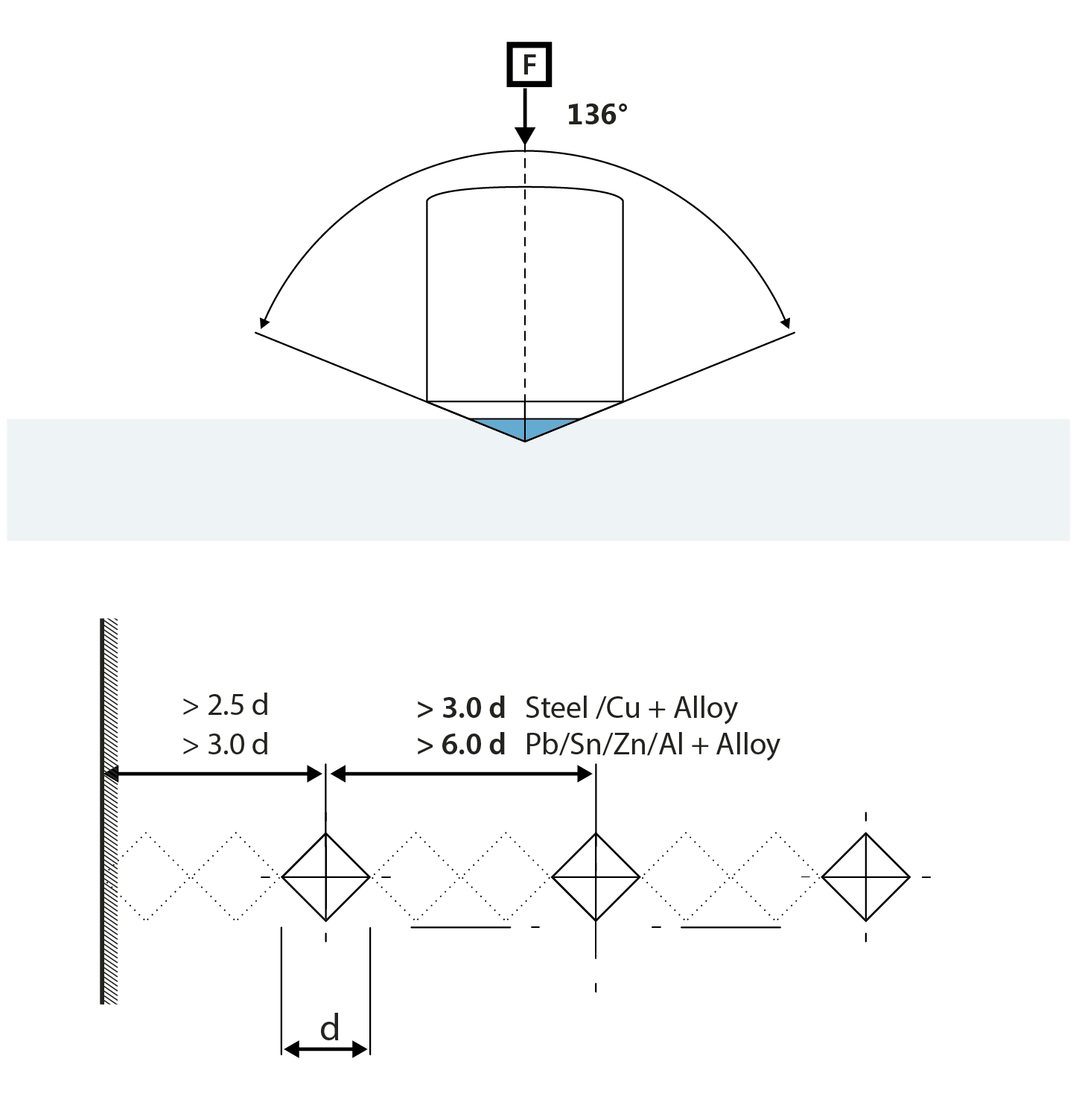
Like other hardness tests, the Vickers method measures a material’s resistance to plastic deformation. It uses a diamond-shaped indenter in the form of a square-based pyramid, which is pressed into the surface of the test material under a controlled load.
An indentation will be left behind after the process, and this is measured diagonally. The result is called the Vickers Pyramid Number (HV), also known as Diamond Pyramid Hardness (DPH). Because of its precision, this test is suitable for assessing both micro and macro hardness.
To guarantee reliable and precise results, the micro Vickers hardness test follows these essential principles:
Vickers hardness values are reported using a standardized format such as xxxHVyy, for example 440HV30, or xxxHVyy/zz, where:
If the dwell time differs from the standard (10 to 15 seconds), it is included as well:
440HV30/20 indicates a 20-second load time.
Vickers hardness testers are used across industries for:
The method is preferred for its ability to provide tensile strength correlations, and insights into wear resistance and ductility. While Vickers results are generally independent of the applied test force (within 500 gf to 50 kgf), care must be taken to space indentations at least three diameters apart to avoid work-hardened interference.
Common fields of use include:
INNOVATEST offers various Vickers hardness testers that are closed loop, load cell-based machines. Our instruments are developed, designed and endurance tested at our R&D facilities, and offer our customers the choice between basic manual testing or fully automatic Vickers testing.
All instruments are equipped with user-friendly, advanced IMPRESSIONS software, which allows for ease of use while accommodating complex applications and workflows. In addition, all critical internal electronic components are manufactured by INNOVATEST, allowing for a high level of manufacturing quality control and ensuring a reliable hardness testing instrument for many years, backed by our extended warranty options.
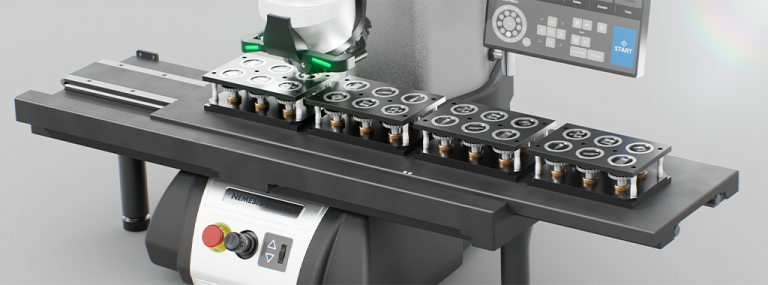
Choosing the right hardness tester depends on your material type, load requirements, and testing environment.
Already have testing requirements in mind?
Use Our Configuration Tool
Our proprietary tool makes it easy to match your specs to the right solution. Instantly receive tailored recommendations and pricing to support faster, more informed decisions.
To use a Vickers tester, a diamond pyramid-shaped indenter is pressed into the material using a precise load. After the load is removed, the diagonals of the indentation are measured to calculate the Vickers Hardness Number (VHN).
Vickers hardness is a measure of a material’s resistance to plastic deformation, calculated from the size of an indentation made by a diamond pyramid under a known load.
The Vickers test is a micro- or macro-indentation hardness test using a diamond pyramid indenter and precise loads. It is suitable for a wide range of materials, including metals and ceramics.
The Vickers test is used for evaluating surface hardness in thin materials, coatings, and precision components. It’s commonly applied in research, quality control, and metallurgical analysis.
Vickers hardness is measured by applying a load to a diamond indenter, measuring the diagonals of the resulting square-shaped indentation, and calculating the hardness value using the standard Vickers formula.
INNOVATEST Rockwell hardness testers are designed for both standard and superficial Rockwell testing methods. These testers follow the procedures outlined in ISO 6508, ASTM E18, JIS Z2245, the most widely used standards for measuring material hardness globally.
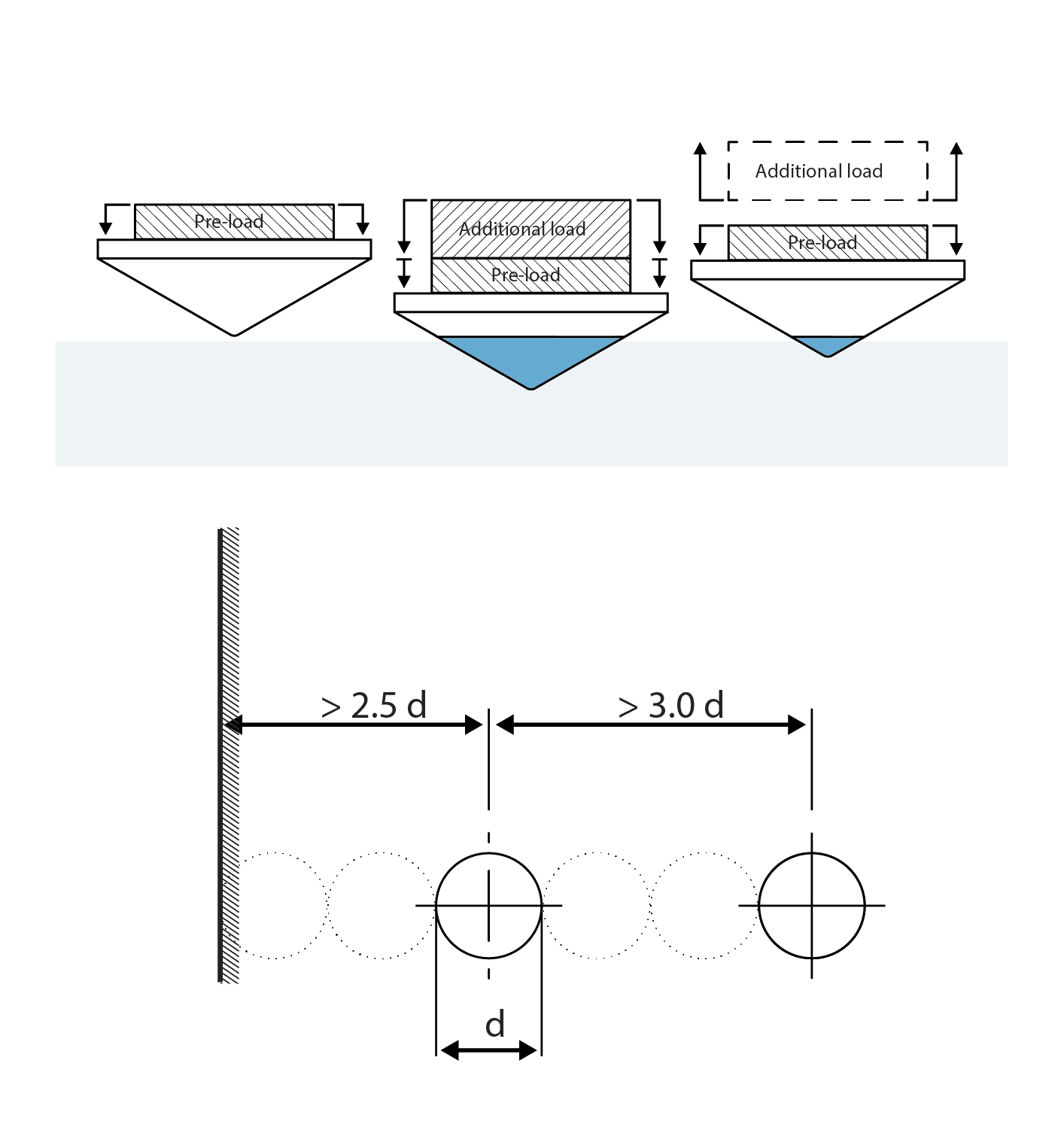
Manual, semi-automatic and fully automatic Rockwell hardness tester methods are applied to a broad range of metals and plastics. The method works by measuring the depth of a permanent indentation created by a defined indenter under a specific (pre) load.
Depending on the material and application, different Rockwell scales may be used, such as Rockwell HRC for harder steels, HRB for softer metals like brass, and superficial scales for thin materials or coatings.
With minimal sample preparation required, the Rockwell test remains one of the fastest and most user-friendly hardness testing methods used across diverse industries. The main advantages of using a hardness tester with the Rockwell method are:
First, a minor load (preload) is applied to establish a zero or reference point. Then, a major load is added to reach the full test force and is held for a set dwell time to account for elastic recovery in the material. Once the major load is removed, the minor load remains in place, and the depth difference from the original reference point is used to calculate the Rockwell hardness value.
INNOVATEST offers various dedicated Rockwell hardness testers that are closed loop, load cell-based machines. Our instruments are developed, designed and endurance tested at our R&D facilities, and offer our customers the choice between basic manual testing or fully automatic Rockwell testing
All instruments are equipped with user-friendly, advanced IMPRESSIONS software, which allows for ease of use while accommodating complex applications and workflows. In addition, all critical internal electronic components are manufactured by INNOVATEST, allowing for a high level of manufacturing quality control and ensuring a reliable hardness testing instrument for many years, backed by our extended warranty options.
Choosing the right hardness tester depends on your material type, load requirements, and testing environment.
Already have testing requirements in mind?
Use Our Configuration Tool
Our proprietary tool makes it easy to match your specs to the right solution. Instantly receive tailored recommendations and pricing to support faster, more informed decisions.
To use a Rockwell hardness tester, apply a minor load (typically 10 kgf) to seat the indenter, followed by a major load. Remove after holding the major load for a set time. The depth of indentation is measured to calculate the Rockwell Hardness Number (HR).
Rockwell C represents a harder material than Rockwell B. The C scale (HRC) is used for harder steels, while the B scale (HRB) is used for softer metals like brass or aluminium alloys.
Rockwell hardness is tested by applying a two-stage load to an indenter on the test surface: first a minor load, then a major load. The depth difference after removing the major load is used to determine the Rockwell hardness value.
There is no universal “ideal” Rockwell hardness. Ideal values depend on application. For example, knife blades range from 55–62 HRC, structural steel around 20–30 HRC, and brass fittings around 60–80 HRB.
The Brinell hardness tester uses the oldest method of hardness testing still in widespread use. Developed in 1900 by Swedish engineer Dr. Johan August Brinell, this technique (standardized as ISO 6506, ASTM E10, JIS Z 2243) is especially suited for measuring the hardness of castings and forgings with grain structures too rough for Rockwell or Vickers testing.
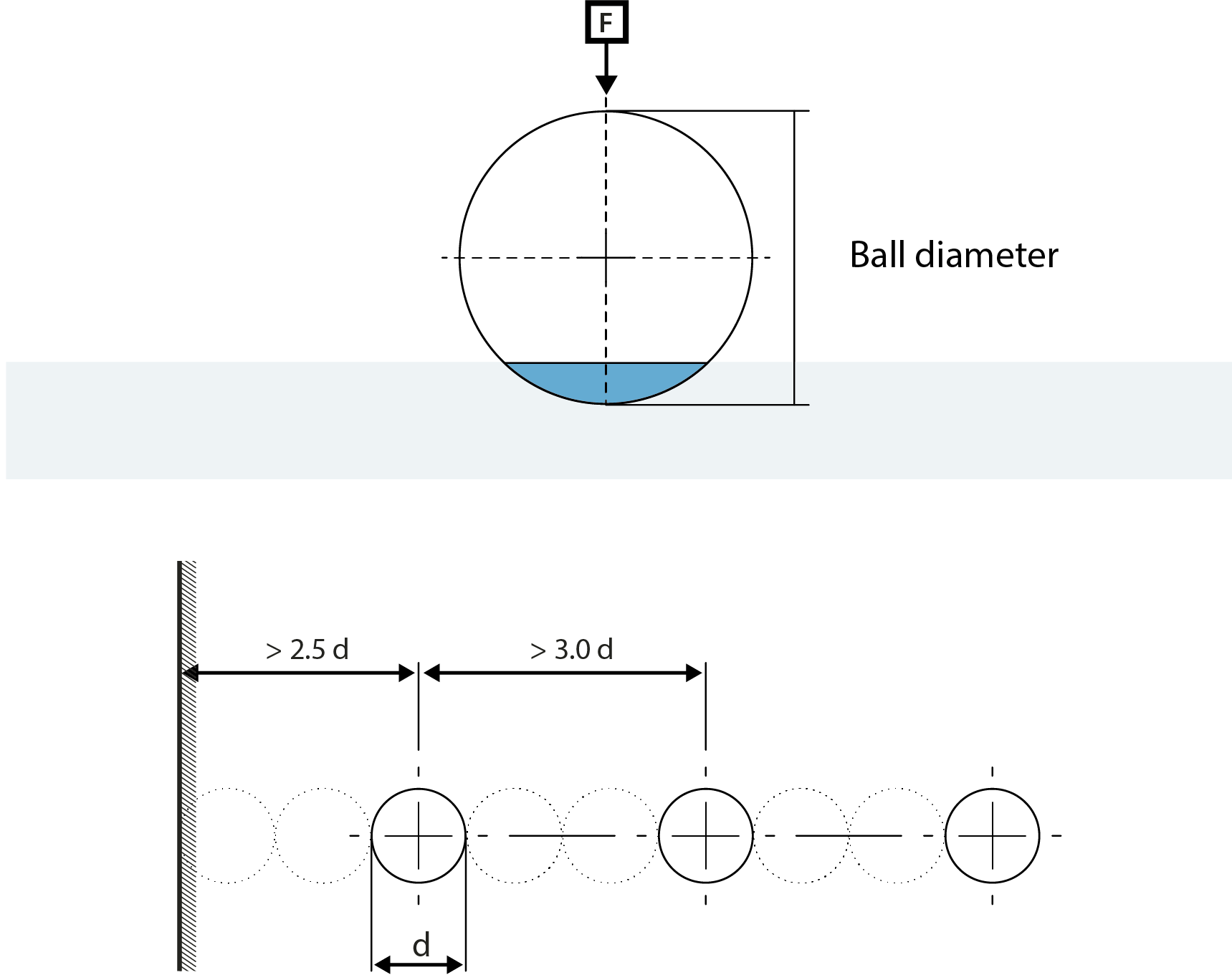
Brinell hardness test conditions have approximately 25 different load/ball combinations. This allows almost all metals to be tested using the Brinell hardness test (HBW) by simply varying the ball size and test force based on the sample’s dimensions and design. The concept is the same whether a digital Brinell hardness tester or a handheld Brinell hardness tester is used. In some cases, as long as the ball size to test the force ratio remains constant, the results are considered accurate when changing between Brinell test conditions.
The HBW Brinell scale (where “H” stands for hardness, “B” for Brinell, and “W” for a tungsten carbide ball) is the most commonly used variant, especially for ferrous and non-ferrous metals.
Results from the Brinell hardness tester are used extensively in industry as a basis for commercial shipment acceptance and quality control. The hardness values obtained from the Brinell test can also provide insights into other material properties, including:
Our Brinell hardness testers can withstand the most harsh environments. If necessary, they can be used with an air filtration system to protect the interior against dust. The testers are available in various formats, including the portable Brinell hardness tester for on-site applications, as well as bench-mounted and floor-standing models for high-precision testing in lab or industrial settings.
INNOVATEST offers various dedicated Brinell hardness testers that are closed loop, loadcell-based machines. Our instruments are developed, designed and endurance tested at our R&D facilities, and offer our customers the choice between basic manual testing or fully automatic Brinell testing.
All instruments are equipped with user friendly, advanced IMPRESSIONS software which allows for ease of use, while accommodating for complex applications and workflows. In addition, all critical internal electronic components are manufactured by INNOVATEST, allowing for a high level of manufacturing quality control, and ensuring a reliable hardness testing instrument for many years, backed by our extended warranty options.
Choosing the right hardness tester depends on your material type, load requirements, and testing environment.
Already have testing requirements in mind?
Use Our Configuration Tool
Our proprietary tool makes it easy to match your specs to the right solution. Instantly receive tailored recommendations and pricing to support faster, more informed decisions.
The Brinell test can be simply explained as an indentation hardness test consisting of two basic steps.
Step 1: Indentation
Step 2: Measurement
The Brinell hardness test (HBW) uses a tungsten carbide ball as the indenter and applies a specified load to measure material hardness. “HBW” is the standard designation in this method, where “W” refers to the tungsten carbide material of the ball.
ISO 6506 is the international standard that outlines the procedures and requirements for performing Brinell hardness testing on metallic materials. It covers the use of different ball sizes, test loads, and the calculation of hardness values.
The Brinell hardness test is performed using a specialized machine called a Brinell hardness tester. It uses a steel or tungsten carbide ball to indent the material under a specific load, then measures the diameter of the indentation to calculate the Brinell Hardness Number (BHN).
Brinell hardness is tested by pressing a hard ball into the surface of a material using a known force for a set dwell time. The diameter of the resulting indentation is measured, and the Brinell Hardness Number (BHN) is calculated using a standard formula.
A Brinell hardness tester measures the resistance of a material to indentation. It helps determine material properties like strength and wear resistance.
The minimum recommended thickness for Brinell hardness testing is 8 times the depth of the indentation. This minimum requirement is set to ensure the test base does not affect the test results.
Typical steels have a Brinell Hardness Number (BHN) ranging from 120 to 600, depending on the grade and heat treatment. For example, mild steel is around 120–180 BHN, while hardened tool steels can range from 600–900 BHN.
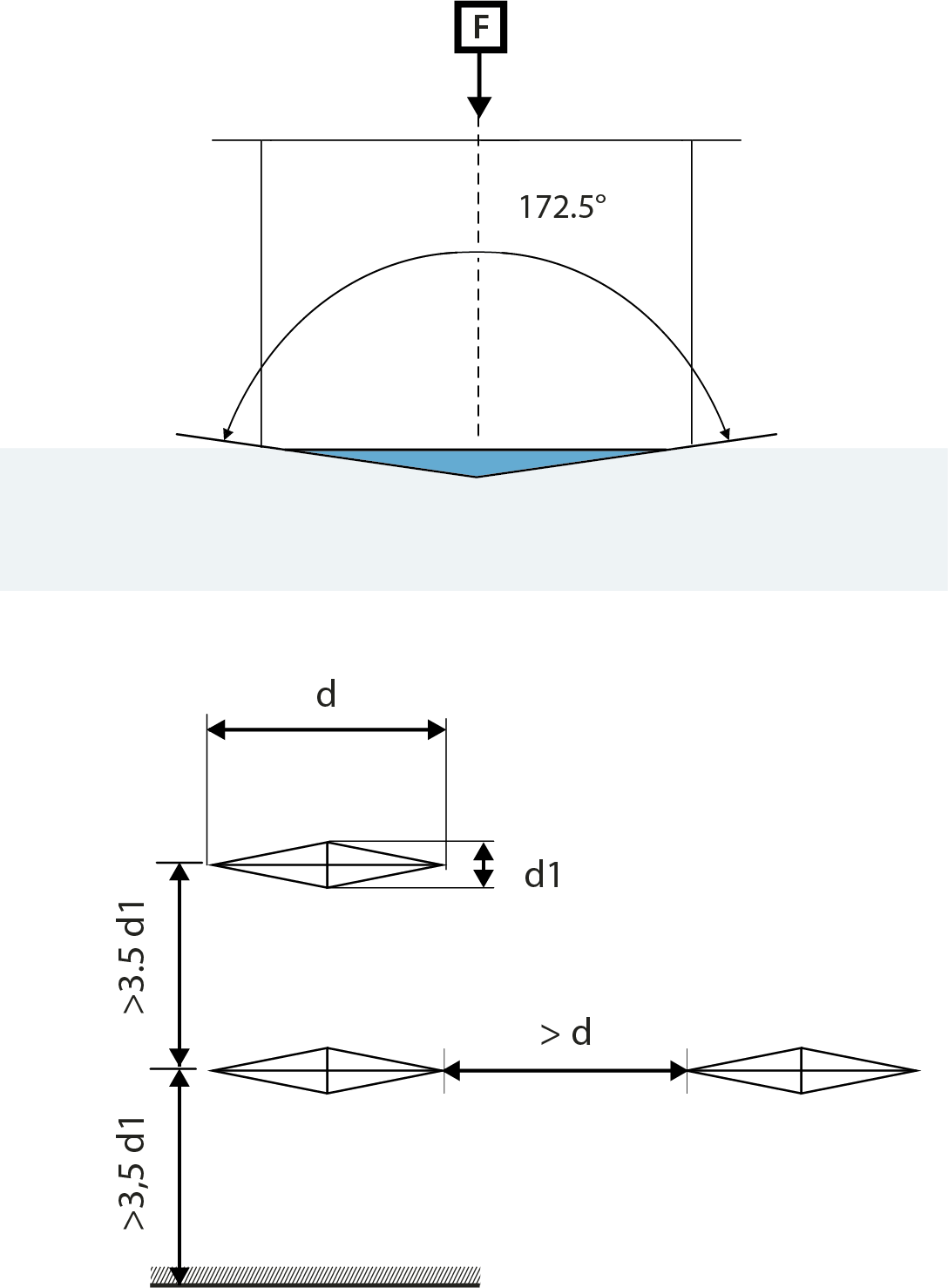
The Knoop hardness tester is designed for microhardness testing, which refers to evaluating very thin materials, coatings, or brittle samples where only a minimal indentation is acceptable. This hardness testing method uses a low test force and a uniquely shaped diamond indenter to deliver precise hardness measurements at the microscale. The process of testing has been documented in ISO 4545, ASTME92 and JIS B7725.
INNOVATEST Knoop hardness testers, manufactured in the Netherlands, are engineered for accuracy and reliability. We offer one of the largest selections of microhardness testers, backed by expert service and support.
While both Knoop and Vickers tests fall under microhardness testing, they differ in indentation geometry and measurement sensitivity:
Knoop indentations are elongated and asymmetrical, which allows for more precise hardness mapping over very small distances. Meanwhile, Vickers indentations are square and symmetrical, offering more stable readings at slightly higher forces.
Knoop microhardness testing for thin coatings and soft materials
Knoop microhardness testers are generally preferred when dealing with thin coatings or delicate materials. They’re especially suitable for test forces below 200 gf, where variations in measurement are more likely.
The Knoop hardness test applies a precision diamond indenter with a long and short diagonal, creating an elongated indentation. The test force typically ranges from 10 gf to 1000 gf, though special cases may use up to 2 or 5 kgf.
Knoop is not commonly used to measure bulk hardness, except in specific cases like 500 gf, where ASTM standards provide conversions to other scales. Larger test forces may be used, but variations can happen depending on the material and setup.
The Knoop method is especially valuable for testing the variations of hardness over small features, cross-sections, or surface gradients.
How to prepare samples for Knoop hardness testing
Proper sample preparation is critical for Knoop testing. Surface imperfections such as corrosion, scratches, or deformation can significantly affect results, especially at lower test forces. Removing all surface damage ensures accurate and repeatable measurements.
How to interpret Knoop hardness results

INNOVATEST KNOOP HARDNESS TESTERS
INNOVATEST offers various hardness testers offering the KNOOP scales that are closed loop, load cell-based machines. Our instruments are developed, designed and endurance tested at our R&D facilities, and offer our customers the choice between basic manual testing or fully automatic Knoop testing.
All instruments are equipped with user-friendly, advanced IMPRESSIONS software which allows for ease of use while accommodating complex applications and workflows. In addition, all critical internal electronic components are manufactured by INNOVATEST, allowing for a high level of manufacturing quality control, and ensuring a reliable hardness testing instrument for many years, backed by our extended warranty options.
Choosing the right hardness tester depends on your material type, load requirements, and testing environment.
Already have testing requirements in mind?
Use Our Configuration Tool
Our proprietary tool makes it easy to match your specs to the right solution. Instantly receive tailored recommendations and pricing to support faster, more informed decisions.
|
|
|
| |
VICKERS | ROCKWELL | BRINELL |
The Knoop hardness test is used for measuring very thin materials, coatings, or small parts. It’s especially useful in microhardness testing for ceramics, composites, and metallographic samples.
Both are microhardness tests, but Knoop uses an elongated diamond-shaped indenter that produces a shallow indentation, ideal for thin samples. Vickers uses a symmetrical diamond pyramid and is better for isotropic materials.
Knoop hardness values (HK) can range from below 100 for soft metals to over 2000 HK for hard ceramics and coatings.
HK stands for Knoop Hardness Number, indicating a material’s resistance to indentation under very light loads, typically measured in microhardness testing.
Case Hardening Depth (CHD) testing is one of the most critical hardness testing applications in modern manufacturing. It is used to verify the effective hardened layer depth of heat-treated components and ensure that parts meet the required mechanical performance for wear resistance, fatigue strength, and service life.
Across industries such as automotive, aerospace, tooling, energy, and fastener manufacturing, accurate case depth hardness testing is essential for validating heat treatment processes such as carburizing, induction hardening, flame hardening, and nitriding.
Incorrect case depth can lead to premature failure, poor wear resistance, reduced fatigue life, and costly product rejection. That is why CHD testing remains one of the most important quality control procedures in hardness testing.
What is Case Hardening Depth (CHD)?
Case Hardening Depth refers to the effective depth of the hardened surface layer created during a heat treatment process.
This hardened layer improves:
The softer core material underneath maintains toughness and impact resistance, creating the ideal balance between strength and flexibility.
CHD testing determines how deep this hardened layer extends below the surface.
Types of Hardness Depth Testing
Different heat treatment processes require different types of hardness depth evaluation.
CHD – Case Hardening Depth
Used primarily for carburized steel components where carbon is diffused into the surface to increase hardness.
Typical applications:
SHD – Surface Hardening Depth
Used for induction hardened or flame hardened materials where surface hardness must be controlled and verified.
Typical applications:
NHD – Nitrided Hardness Depth
Used for nitrided components where nitrogen diffusion creates a hard wear-resistant surface layer.
Typical applications:
How CHD Testing is Performed
CHD testing is typically performed using Vickers hardness testing or microhardness testing, where a hardness traverse is created from the surface toward the core of the material.
A line of indentations is placed at controlled distances from the edge:
The effective case depth is determined at the point where hardness falls to the specified standard limit.
This allows precise verification of whether the heat treatment process has produced the required hardened layer.
Common Standards for CHD Testing
Case depth hardness testing must comply with international standards to ensure valid and repeatable results.
Common standards include:
These standards define:
Standards compliance is critical for certification and audit readiness.
Automatic CHD Testing with Modern Hardness Testers
Traditional manual CHD testing can be slow and highly dependent on operator experience.
Modern hardness testing systems use:
This transforms manual case depth testing into a fully automated and highly repeatable process.
Automation improves:
This is especially important for high-volume production environments.
Applications of Case Depth Hardness Testing
CHD testing is essential wherever heat-treated components are used in high-performance applications.
Automotive Industry
Aerospace Industry
Tooling and Manufacturing
Fastener Manufacturing
Energy and Heavy Industry
In all these industries, reliable CHD testing protects performance and product safety.
CHD Testing vs Surface Hardness Testing
Surface hardness alone does not guarantee correct heat treatment.
A component may show correct surface hardness while having insufficient hardened depth underneath.
Surface Hardness Testing Only
Full CHD Testing
This is why CHD testing is often mandatory for critical components.
Why Accurate CHD Testing Matters
Incorrect case depth can cause:
Accurate case depth testing protects both quality and profitability.
Automated CHD Testing for Modern Quality Control
Today’s advanced hardness testing systems combine:
This creates a complete solution for automated case hardening depth testing built for modern manufacturing environments.
For companies focused on productivity, traceability, and compliance, CHD testing is no longer optional—it is a core part of quality assurance.
Do you want to learn more about how INNOVATEST can support you with automating your CHD testing procedures?
Weld hardness testing is one of the most important quality control procedures used to verify the mechanical integrity, safety, and long-term performance of welded components.
Across industries such as oil & gas, aerospace, automotive, construction, energy, and heavy manufacturing, weld hardness testing ensures that welded joints meet required standards for strength, toughness, fatigue resistance, and crack prevention.
Incorrect weld hardness can lead to brittle weld zones, cracking, premature failure, and costly production rejection. That is why accurate hardness testing of welded components is essential for both certification and long-term reliability.
What is Weld Hardness Testing?
Weld hardness testing measures the hardness values across a welded joint to evaluate the effect of the welding process on the material.
The test is typically performed across three critical zones:
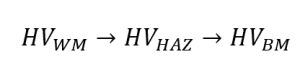
Where:
This hardness traverse helps determine whether the weld process has created undesirable hardness peaks, soft zones, or brittle areas that could lead to failure.
Why Weld Hardness Testing is Important
During welding, the material experiences extreme localized heating and cooling, which can significantly alter mechanical properties.
Weld hardness testing helps verify:
This is especially critical in safety-related and pressure-bearing applications.
Common Hardness Testing Methods for Welds
Vickers Hardness Testing
The most common method for weld hardness inspection, especially for precise testing across weld zones.
Best For:
Common Standards:
Vickers is the preferred method for most weld hardness applications.
Brinell Hardness Testing
Used for larger welded structures and heavier materials where a larger indentation is beneficial.
Best For:
Common Standards:
Rockwell Hardness Testing
Used for faster production checks where general weld hardness verification is required.
Best For:
Common Standards:
ISO 9015 – Weld Hardness Testing Standard
One of the most important standards for weld hardness testing is:
ISO 9015
Destructive tests on welds in metallic materials – Hardness testing
This standard defines:
ISO 9015 ensures consistent and repeatable weld hardness inspection across laboratories and industries.
Compliance with ISO 9015 is often mandatory for certification work.
Automated Weld Hardness Testing
Traditional manual weld hardness testing can be slow and highly dependent on operator experience.
Modern systems use:
This transforms weld hardness inspection into a fast, repeatable, and highly efficient process.
Automation improves:
This is especially valuable in high-volume production and certification laboratories.
Applications of Weld Hardness Testing
Weld hardness testing is critical wherever weld integrity affects safety and product performance.
Oil & Gas Industry
Aerospace Industry
Automotive Industry
Energy Sector
Heavy Industry
In all these industries, weld failure is not an option.
Weld Hardness Testing vs Visual Weld Inspection
Visual inspection alone cannot confirm weld integrity.
Visual Inspection Only
Full Weld Hardness Testing
This is why weld hardness testing is essential—not optional.
Common Causes of Weld Hardness Failure
Excessive weld hardness can result from:
Testing allows these problems to be identified before the component enters service.
Why Accurate Weld Hardness Testing Matters
Incorrect weld hardness can cause:
Accurate weld hardness testing protects lives, assets, and reputation.
Modern Solutions for Automated Weld Quality Control
Today’s advanced hardness testing systems combine:
This creates a complete solution for automated weld hardness testing built for modern manufacturing and certification environments.
For companies focused on compliance, reliability, and productivity, weld hardness testing is one of the most valuable quality control investments available.
Do you want to learn more about how INNOVATEST can support you with automating your Weld hardness testing procedures?
Hardness conversion charts are essential tools in modern material testing, allowing manufacturers, laboratories, and quality control teams to compare hardness values across different testing methods such as Rockwell, Brinell, Vickers, and Knoop hardness testing.
Because different industries, standards, and customers often specify different hardness scales, reliable hardness conversion is critical for accurate reporting, compliance, and communication.
Whether testing heat-treated gears, fasteners, welded components, aerospace alloys, or large castings, correct hardness value conversion helps ensure consistent decision-making and full standards compliance.
What is Hardness Conversion?
Hardness conversion is the process of translating a hardness value measured in one scale into an equivalent value in another scale.
For example:
This allows manufacturers to meet customer specifications even when testing is performed using a different hardness method.
Example:
Conversion must always follow approved international standards to ensure accuracy.
Why Hardness Conversion is Important
Different industries use different hardness scales depending on the material and application.
Examples:
Without proper conversion, comparing results between suppliers, customers, and production sites becomes difficult.
Hardness conversion helps:
It is one of the most important functions in professional hardness testing software.
Common Hardness Scales
Rockwell Hardness (HR)
Used for fast production testing and high-throughput manufacturing.
Common scales include:
Most common for:
Brinell Hardness (HBW)
Used for larger materials and coarse structures.
Most common for:
Vickers Hardness (HV)
Used for precision testing and microhardness applications.
Most common for:
Knoop Hardness (HK)
Used for brittle materials and extremely thin sections.
Most common for:
International Standards for Hardness Conversion
Hardness conversion should never be estimated manually. It must follow approved standards.
The most important standards are:
ISO 18265
Metallic materials — Conversion of hardness values
This is the primary international standard for converting:
ASTM E140
Standard Hardness Conversion Tables for Metals
Widely used across North America and global manufacturing for:
DIN and Customer-Specific Standards
Some industries also require:
Using the correct standard is critical for compliance.
Automatic Hardness Conversion in Modern Hardness Testers
Modern hardness testing systems automatically perform hardness conversion during testing and reporting.
This includes:
This improves:
Manual conversion tables are no longer enough for modern quality control.
Applications of Hardness Conversion
Hardness conversion is critical across many industries.
Automotive Industry
Customers often request HRC while testing may be performed in HV.
Aerospace Industry
Precise conversion between HV and HRC is often required.
Fastener Manufacturing
Hardness values must often be converted to comply with ISO fastener standards.
Heat Treatment and Tooling
Foundries and Heavy Industry
Conversion between Brinell and Rockwell is common.
Hardness Conversion vs Direct Testing
While conversion is useful, it should not replace correct testing where possible.
Direct Hardness Testing
Hardness Conversion
Conversion supports quality control—but does not replace proper testing standards.
Common Mistakes in Hardness Conversion
Incorrect conversion can happen when:
These mistakes can cause:
Accurate conversion protects both quality and profitability.
Why Hardness Conversion Matters
Modern manufacturing demands fast reporting, international compliance, and full traceability.
Hardness conversion allows laboratories to:
This makes hardness conversion one of the most powerful tools in professional hardness testing.
Smart Hardness Testing with Automatic Conversion
Today’s advanced hardness testing systems combine:
This creates a complete solution for modern hardness testing and data management.
For laboratories focused on precision, compliance, and productivity, automatic hardness conversion is no longer optional—it is essential.
Do you want to learn more about how INNOVATEST can support you with automating your hardness conversions?
ASK A QUESTION ABOUT HARDNESS TESTING CONVERSIONS
REQUEST A FREE HARDNESS TESTING CONVERSION POSTER FOR YOUR LABORATORY
Micro hardness testing is one of the most precise and important methods used in modern material testing for evaluating thin layers, small components, coatings, weld zones, and heat-treated surfaces.
Unlike standard macro hardness testing methods such as Rockwell or Brinell, micro hardness testing uses very small test forces and highly accurate optical measurement to determine hardness in areas where standard indentation methods would be too large or too destructive.
Across industries such as aerospace, automotive, medical devices, electronics, coatings, metallurgy, and research laboratories, micro hardness testing is critical for quality control, failure analysis, and advanced material development.
When precision matters most, micro hardness testing becomes essential.
What is Micro Hardness Testing?
Micro hardness testing measures the hardness of a material using very low test forces, typically ranging from a few grams to 1 kilogram-force (gf to kgf).
Because the indentation is extremely small, the method is ideal for testing:
The two most common methods are:
Both methods use optical measurement of the indentation rather than depth measurement.
Vickers Micro Hardness Testing
The Most Common Micro hardness Method
Vickers micro hardness testing uses a diamond pyramid indenter and measures the diagonal length of the indentation.
Where:
Best For:
Common Standards:
Vickers is the most widely used micro hardness method in industrial laboratories.
Knoop Hardness Testing
Ideal for Very Thin Layers and Brittle Materials
Knoop hardness testing uses an elongated diamond indenter that creates a shallow indentation, making it ideal for extremely thin or fragile materials.
Best For:
Common Standards:
Knoop is especially useful where minimal penetration depth is required.
Micro hardness vs Macro hardness Testing
Understanding the difference between micro hardness testing and macro hardness testing is essential for selecting the correct method.
Macro hardness Testing
Methods include:
Best for:
Micro hardness Testing
Methods include:
Best for:
The smaller the area being tested, the more important micro hardness becomes.
Applications of Micro hardness Testing
Micro hardness testing is used wherever detailed localized hardness analysis is required.
Case Hardening Depth (CHD)
Used to determine the effective hardened depth of carburized, nitrided, and induction hardened components.
Typical applications:
Weld Hardness Testing
Used to evaluate:
This is critical for:
Coating Thickness and Surface Treatments
Used for:
This ensures proper coating performance and wear resistance.
Metallography and Failure Analysis
Used to investigate:
This supports advanced R&D and root cause investigations.
Automatic Micro hardness Testing
Traditional manual micro hardness testing can be slow and highly dependent on operator skill.
Modern systems use:
This improves:
Automation is now the standard for professional micro hardness laboratories.
Common Standards for Micro hardness Testing
Reliable micro hardness testing must follow international standards.
Most important include:
ISO 6507
Vickers hardness testing standard
ASTM E384
Micro indentation hardness of materials
ASTM E92
Vickers hardness and micro hardness testing
ISO 9015
Weld hardness testing
ISO 2639
Case hardening depth testing
These standards define:
Standards compliance is essential for audits and certification.
Common Challenges in Micro hardness Testing
Micro hardness testing requires precision. Common problems include:
Modern software solves these challenges through:
This improves both speed and confidence.
Why Accurate Micro hardness Testing Matters
Incorrect micro hardness testing can cause:
Because these applications are often safety-critical, precision is non-negotiable.
Modern Solutions for Advanced Micro hardness Testing
Today’s advanced hardness testing systems combine:
This creates a complete solution for automated micro hardness testing built for modern laboratories and production environments.
For companies focused on precision, compliance, and advanced material analysis, micro hardness testing is one of the most powerful tools in quality assurance.
Do you want to learn more about how INNOVATEST can support you with micro hardness testing?